
Human Life and Family
Respect for Life from Conception to Natural Death
Family Global Compact Barcelona: an exemplary collaboration in the face of the challenges of euthanasia and assisted suicide
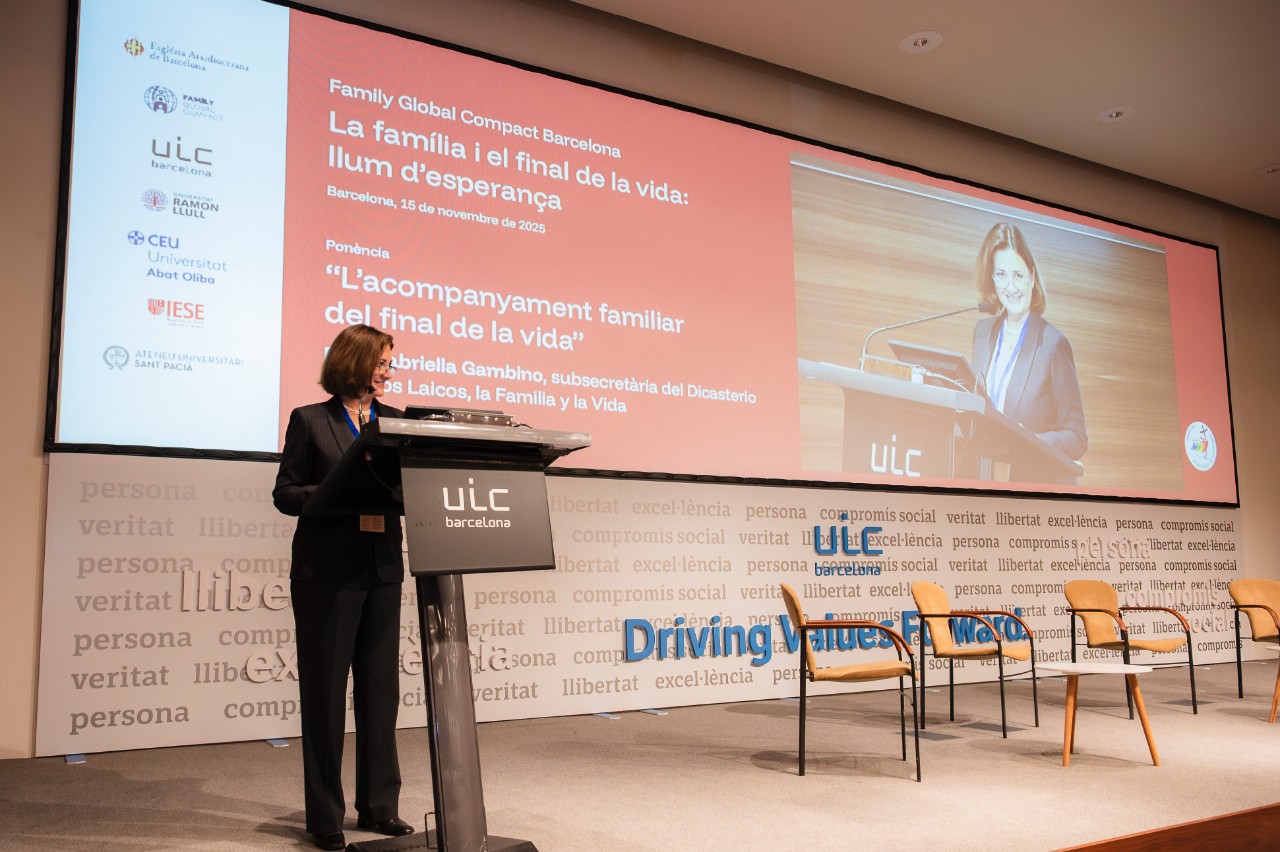
On 15 November, Prof. Gabriella Gambino, Undersecretary of the Dicastery for Laity, Family and Life, took part in a study day organized by the Family Global Compact Barcelona platform, coordinated by the Archdiocese. The event, titled “Family and the end of life: a light of hope”, aimed to place the value of life at the centre of society’s attention, so that increasing longevity and accompaniment at the end of life may become a gift of a life filled with hope.
The alliance between academic knowledge and pastoral care
In her address, Undersecretary Gambino emphasized that the working group set up by the Archdiocese “is a shining example of how it is possible to carry out an exemplary collaboration between academic knowledge and pastoral action in the Church. It is of utmost importance that scientific research keep its focus on the realities of local communities, engaging in dialogue with the local pastoral care of the family to encourage shared commitment and provide effective formation for lay people on life issues.”
To desacralize death is to desacralize life
The talk, titled “Family accompaniment at the end of human life”, focused on the need to develop a Pastoral Care of Human Life that counters the serious and subtle forms of violations of human dignity that today manifest themselves in laws on euthanasia and assisted suicide. Referring to the recent document “Life Is Always a Good” by the Dicastery for Laity, Family and Life, the Undersecretary urged educators and professionals to develop an ecclesial wisdom capable of influencing culture and social life – contexts in which the sacredness of life appears forgotten.
“The prevailing paradigms in the dominant thought of our time,” Gambino said, “tend to remove old age and the end of life from collective imagination: death is seen only in its tragic dimension, as a biological end, as the end of any possible experience to which meaning could be given, becoming a place of ‘non-sense.’ It is no longer accepted as a passage inscribed in the order of being, but is handled as a choice, turning from an event to be understood into an act to be controlled.” “To desacralize death by emptying it of meaning,” she continued, “has the sole effect of desacralizing life. Only in the awareness of death do we grasp the extraordinary intrinsic value of human life, which does not reside in biological processes but in the symbolic, relational, and spiritual meanings that take root in them.”
Family and care at the end of life: a role not to be taken for granted
This is why, Gambino concluded, the Church’s cultural and pastoral commitment must be directed towards “rediscovering our relational nature, our being-with-others. In particular, the family is the privileged place where life and death can be lived in a fully human way; however, the extreme vulnerability that many family contexts display within themselves requires dedication, preparation, and the capacity to accompany on the part of the Church. The family must be strengthened and supported in its fundamental role: it must be capable of being a strong subject, rooted in its intergenerational relational ties and nourished by the Christian sense of life, which alone can free it from the reductionisms of postmodernity. With this spiritual and cultural nourishment, we must accompany it on its journey, so that each time it may rediscover its identity as a community of love and meaning.”
***
The study day, organized by the Family Global Compact Barcelona platform, coordinated by the Archdiocese, was a true model of exemplary collaboration between academic knowledge and pastoral action in the Church. The platform brings together Abat Oliba University (UAO), the Sant Pacià University Athenaeum, Ramon Llull University (URL), which includes the Borja Institute of Bioethics and Blanquerna University, the International University of Catalonia (UIC), which includes the Institute for Advanced Family Studies (IESF), the WeCare Chair and the Cuides Clinic for palliative care, the Institute of Higher Business Studies (IESE), and the Diocesan Secretariats for the Pastoral Ministries of Health, University, and the Family.
20 November 2025

Una Caro. In Praise of Monogamy
See below the statement by Cardinal ...
Read all >
Peace begins at home: families are the cradle of the future of humanity
On 21 November, the French Catholic ...
Read all >
The measure of true love: a love that is total, faithful and fruitful
On 30 October, the Faculty of Theology ...
Read all >
“Let Us All Become Fishers of Families”
The meeting of the International ...
Read all >