
Marriage and Family
Applying the Catechumenal Pathways for Married Life
8th Interdisciplinary Study Day: The Role of Family and Community in Marriage Preparation
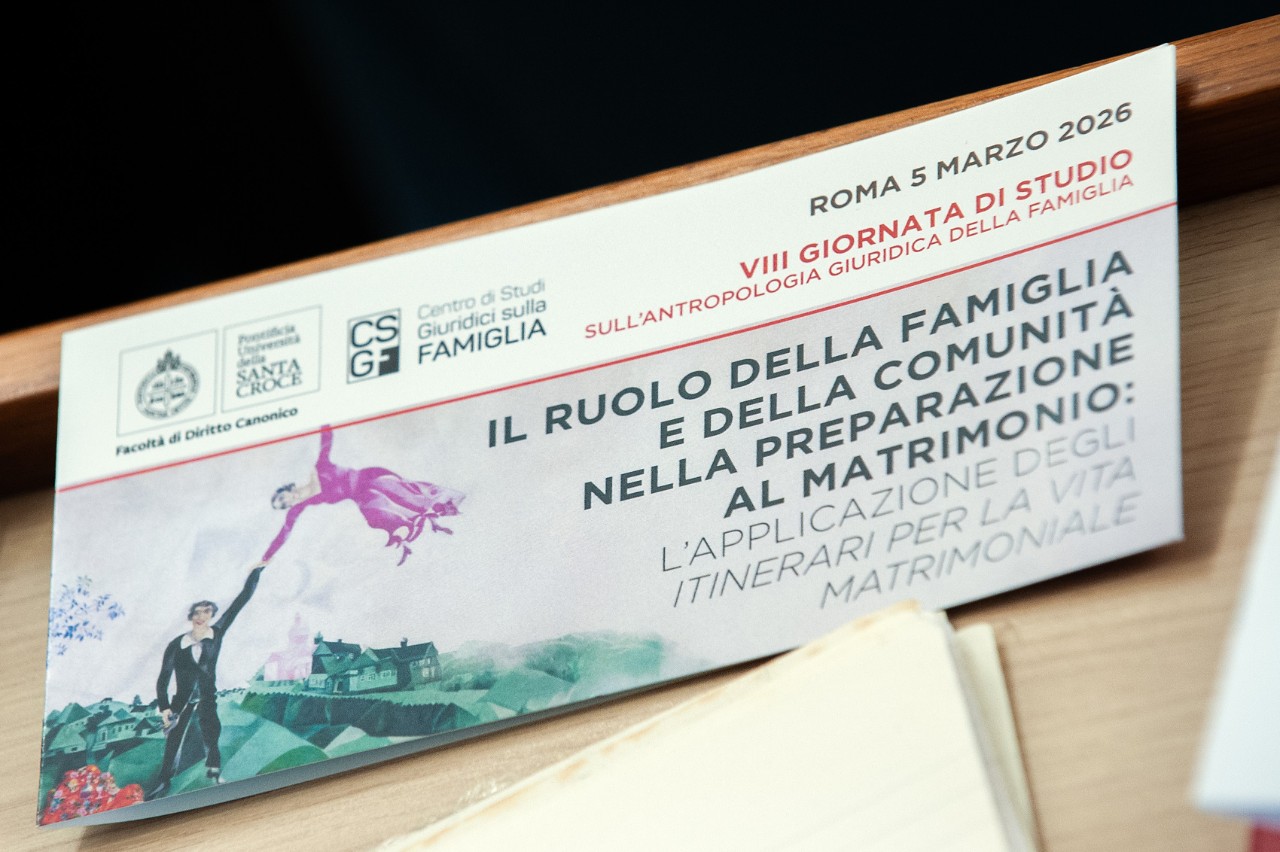
Photo: © Gianni Proietti - Pontifical University of the Holy Cross
On March 5, 2026, the Center for Legal Studies on the Family at the Pontifical University of the Holy Cross organized the eighth edition of the Interdisciplinary Study Day dedicated to the theme “The role of family and community in marriage preparation.” The meeting aimed to explore marriage preparation in light of the Catechumenal Pathways for Married Life, a document of pastoral guidelines for particular Churches published by the Dicastery for Laity, Family and Life in 2022.
Gambino: “Making the relationship between faith and marriage more alive in pastoral practice”
The day was opened by Prof. Gabriella Gambino, Undersecretary of the Dicastery for Laity, Family and Life, with a presentation on the key points of the Pathways, in which she highlighted the challenges that the Church is called to face in order to initiate a renewed and truly fruitful preparation for marriage, capable of accompanying engaged couples on their vocational journey in a context of authentic discernment in the faith. In cultural contexts strongly marked by secularization, there are many marriages celebrated “without understanding their meaning and the content of grace.” With the rite celebrated in the Christian community, the Undersecretary observed, the spouses “are invited to give their consent, adhering in principle to the Church's consciousness of faith” and thus find in it the intention to do what the Church does. “Yet we are all witnesses to how many marriages are now celebrated in the absence of this consciousness of faith, which the Church continues to express in the rite, often giving rise to celebrations of the sacrament that we could define as ‘secularized,’ in which the liturgical form does not correspond to the faithful's understanding of marriage.” As Pope Leo recently observed, “ordinary pastoral care is structured according to a classical model that is primarily concerned with ensuring the administration of the sacraments, but such a model presupposes that faith is somehow transmitted [...] this invites us to be vigilant also about a ‘sacramentalization without other forms of evangelization.’” We are therefore invited to re-examine the way we present the relationship between faith and marriage in order to make it more explicit and alive in pastoral practice. “I am convinced,” Prof. Gambino emphasized, “that the relationship between these two terms is not only a theological issue of great importance, but also constitutes a decisive ecclesiological and pastoral key to understanding the New Evangelization.”
Marriage as a countercultural choice and formation for accompanying engaged couples
During the morning, the key points of the Pathways were addressed, in particular, marriage as a challenging and countercultural choice, and the central role of the family in accompanying engaged couples. In the afternoon, a round table presented concrete experiences of the application of the Pathways, with particular attention to the role of the parish priest, premarital instruction, the formation of couples capable of accompanying families, and guiding young people in discovering their vocation to marriage.
The meeting was attended by various experts and teachers, including Rev. Prof. Giulio Maspero (Pontifical University of the Holy Cross), Dr. Marco Quintiliani (psychiatrist), and Dr. Alessandra Caneva (writer). During the round table discussion, concrete experiences of the application of the marriage catechumenate were presented with contributions from Monsignor Antonio Interguglielmi, Monsignor Emanuele Albanese, Don Jorge García Montagud, Gigi and Anna Chiara De Palo (Angelini Foundation).
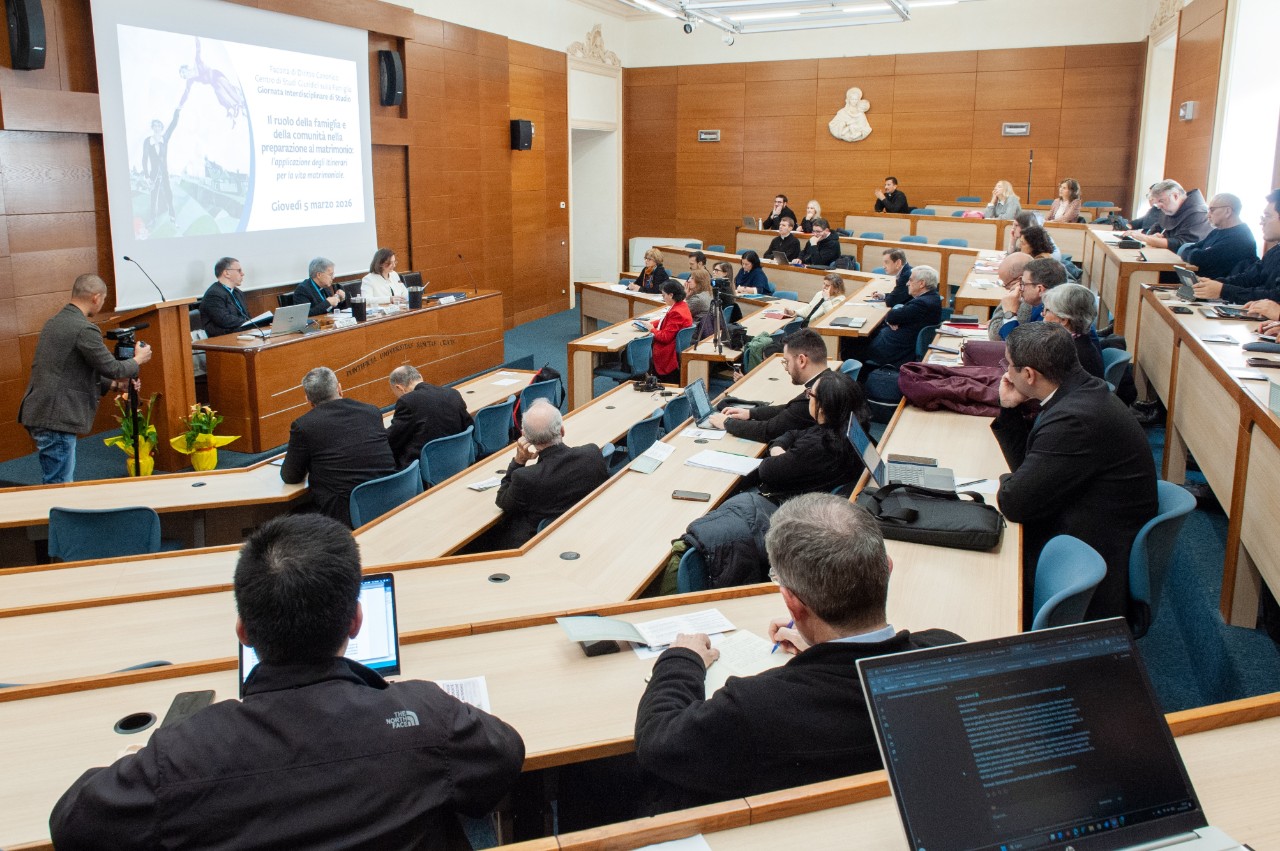
Photo: © Gianni Proietti - Pontifical University of the Holy Cross
06 March 2026
3rd Plenary Assembly: help lay people with basic formation in Christian life
On Wednesday, Cardinal Kevin J. Farrell, ...
Read all >